Simplest Website || Full Content || Point To Point
Vitamin K Benefits, Sources, Uses, Deficiency & Side Effects-19 Facts
Introduction
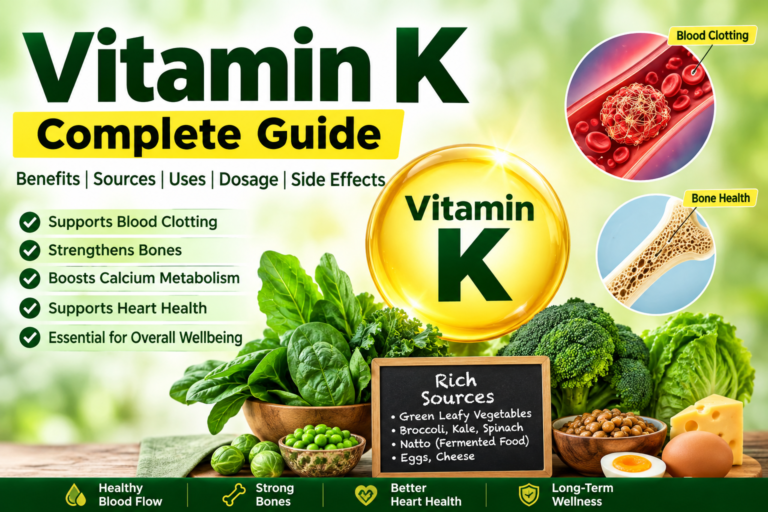
Vitamin K is an essential fat-soluble vitamin that plays a powerful role in blood clotting, bone health, and several important processes in the human body. Although Vitamin K does not always receive as much attention as Vitamin C or Vitamin D, its role in maintaining normal body functions isremarkable.
The body needs Vitamin K to activate certain proteins that are involved in blood coagulation. It also supports proteins associated with bone metabolism and calcium regulation. A deficiency can become a seriousproblem because inadequate Vitamin K may interfere with the body’s normal ability to form blood clots.
Vitamin K is mainly obtained through food. Green leafy vegetables are particularly rich sources of Vitamin K1, while Vitamin K2 occurs in certain fermented foods and animal-derived foods.
There are several forms of Vitamin K, but Vitamin K1 and Vitamin K2 are the most important naturally occurring forms. Understanding the differences between these forms can help you make informed choices about your diet and supplements.
Research Studies of vitamin K
Vitamin K has been the subject of extensive scientific research, particularly for its role in blood clotting, newborn health, bone metabolism and calcium regulation. Researchers have also explored the potential effects of Vitamin K on bone mineral density and fracture risk. Here are some notable scientific studies and reviews:
Vitamin K and Bone Health – Rodríguez-Olleros Rodríguez & Díaz Curiel (2019)
A review published in the Journal of Osteoporosis by Celia Rodríguez-Olleros Rodríguez and Manuel Díaz Curiel examined the relationship between Vitamin K deficiency, Vitamin K supplementation and bone health.
The researchers reported that low Vitamin K1 levels, higher levels of undercarboxylated osteocalcin and lower dietary intake of Vitamin K1 and K2 were associated in several studies with poorer bone-related outcomes. However, they also emphasized that the available evidence was limited and sometimes inconsistent, meaning more high-quality studies are needed before firm conclusions can be made about Vitamin K supplements for preventing fractures.
Effect of Vitamin K on Bone Mineral Density and Fracture Risk – Salma et al. (2022)
A systematic review and meta-analysis by Salma, Syed Sufian Ahmad, Shahid Karim, Ibrahim M. Ibrahim, Huda M. Alkreathy, Mohammed Alsieni and Mohammad Ahmed Khan analyzed clinical research investigating Vitamin K and bone health.
The review included 20 relevant citations and examined randomized controlled trials involving adults. The researchers found lower odds of vertebral and clinical fractures in some Vitamin K groups compared with controls. However, the pooled analysis did not show a statistically significant improvement in femoral bone mineral density. These findings are promising, but they do not establish Vitamin K supplementation as a definitive treatment for osteoporosis.
Updated Systematic Review of Vitamin K and Fractures – Mott et al. (2019)
A. Mott, T. Bradley, K. Wright, E. S. Cockayne, M. J. Shearer, J. Adamson, S. A. Lanham-New and D. J. Torgerson conducted an updated systematic review and meta-analysis of randomized controlled trials.
The researchers identified 36 studies examining oral Vitamin K supplementation and bone mineral density or fractures in adults. Their analysis suggested that Vitamin K might reduce the risk of some clinical fractures in postmenopausal or osteoporotic patients, but there was no convincing evidence that Vitamin K improved vertebral fracture outcomes or consistently increased bone mineral density.
The authors concluded that the evidence was insufficient to confirm a clear protective effect of Vitamin K against fractures, particularly after considering studies with a higher risk of bias.
Vitamin K Prophylaxis for Newborns – Sankar et al. (2016)
A systematic review by M. J. Sankar, A. Chandrasekaran, P. Kumar, A. Thukral, R. Agarwal and V. K. Paul examined Vitamin K prophylaxis for preventing Vitamin K deficiency bleeding in newborns.
The research was conducted by investigators associated with the All India Institute of Medical Sciences (AIIMS), New Delhi, and reviewed evidence surrounding Vitamin K administration in newborns.
The study supports the important role of Vitamin K prophylaxis in preventing Vitamin K deficiency bleeding, a potentially serious condition in infants.
Prevention of Vitamin K Deficiency Bleeding in Newborn Infants – Mihatsch et al. (2016)
Walter A. Mihatsch and colleagues, through the European Society for Paediatric Gastroenterology, Hepatology and Nutrition (ESPGHAN) Committee on Nutrition, published a position paper on preventing Vitamin K deficiency bleeding in newborn infants.
The paper reviewed available evidence and discussed different approaches to Vitamin K administration after birth. It highlights why newborns are particularly vulnerable to Vitamin K deficiency and why Vitamin K prophylaxis is an important preventive measure.
Vitamin K Deficiency Bleeding in Infancy – 2020 Review
A 2020 review on Vitamin K Deficiency Bleeding in Infancy examined why infants are particularly vulnerable to Vitamin K deficiency.
The review explains that newborns have relatively low Vitamin K stores because of factors such as limited placental transfer, low Vitamin K levels in breast milk and immature intestinal flora. It also describes early, classic and late forms of Vitamin K deficiency bleeding. Late-onset Vitamin K deficiency bleeding can be particularly dangerous because serious bleeding, including intracranial bleeding, may occur.
What Does the Research Actually Tell Us?
Overall, scientific research confirms that Vitamin K has an essential biological role, especially in normal blood coagulation. The evidence surrounding newborn Vitamin K prophylaxis is particularly strong, which is why it is widely recommended in neonatal care.
Research on Vitamin K and bone health is more complicated. Several studies have reported promising associations between adequate Vitamin K status and bone health, but systematic reviews have found inconsistent results. Therefore, Vitamin K should not be presented as a guaranteed treatment for osteoporosis or fractures.
Scientists are also continuing to investigate Vitamin K2, cardiovascular health, calcium metabolism and other potential roles. These areas are intriguing, but further high-quality human studies are required before stronger health claims can be made.
Types of Vitamin K
Vitamin K is not a single compound. It refers to a family of related fat-soluble compounds.
Vitamin K1
Vitamin K2
Vitamin K1 is also known as phylloquinone. It is naturally produced by plants and is especially abundant in green leafy vegetables.
Some excellent dietary sources include spinach, kale, broccoli, cabbage, and other green vegetables.
Vitamin K2 is a group of compounds called menaquinones.
Vitamin K2 occurs naturally in certain fermented foods and animal-derived foods. Different forms of Vitamin K2 are identified using the abbreviation MK followed by a number.
Menaquinone-4 (MK-4) – MK-4 is one form of Vitamin K2. It can be found in certain animal-derived foods and can also be produced by the human body from Vitamin K1.
Menaquinone-7 (MK-7) – MK-7 is another form of Vitamin K2. It is particularly associated with fermented foods such as natto, a traditional Japanese fermented soybean food.
Menaquinone-8 and Menaquinone-9 – MK-8 and MK-9 are additional forms of Vitamin K2 that can occur in fermented foods, particularly certain cheeses and other fermented products.
Vitamin K3
Vitamin K3, or menadione, is a synthetic compound with Vitamin K activity. It is different from the naturally occurring K1 and K2 forms and is not generally used as a routine dietary Vitamin K supplement for humans.
What is Vitamin K ?
Vitamin K is a powerful and essentialfat-soluble vitamin required for normal blood coagulation.
The name Vitamin K comes from the German word Koagulation, referring to the process of blood clotting.
When a blood vessel is injured, the body needs to form a clot to prevent excessive blood loss. Vitamin K helps activate several proteins required for this process.
But blood clotting is not the only reason Vitamin K is important. Vitamin K-dependent proteins are also involved in bone metabolism and calcium regulation.
Because Vitamin K is fat-soluble, its absorption is connected to dietary fat and normal fat digestion and absorption.
Scientific Classification
Property
Details
Vitamin Name
Vitamin K
Vitamin Type
Fat-soluble vitamin
Main Natural Forms
Vitamin K1 and Vitamin K2
Vitamin K1
Phylloquinone
Vitamin K2
Menaquinones
Synthetic Form
Menadione (Vitamin K3)
Solubility
Fat-soluble
Main Role
Normal blood coagulation
Other Important Roles
Bone metabolism and calcium-related processes
Vitamin K belongs to a family of structurally related compounds rather than being a single chemical substance.
Sources of Vitamin K
Richest sources of Vitamin K1
Richest sources of Vitamin K2
Kale
Spinach
Collard greens
Broccoli
Cabbage
Lettuce
Parsley
Green beans
Green peas
Brussels sprouts
Soybeans
Natto
Certain fermented foods
Some cheeses
Eggs
Meat
Dairy products
Richest sources of Vitamin K3
Menadione
Menadione sodium bisulfite (MSB)
Menadione sodium bisulfite complex (MSBC)
Menadione nicotinamide bisulfite (MNB)
Synthetic Vitamin K3 preparations
Animal-feed vitamin premixes
Poultry-feed supplements
Livestock-feed supplements
Aquaculture/fish-feed supplements
Chemical Composition of Vitamin K
Vitamin K represents a group of structurally related compounds based on a 2-methyl-1,4-naphthoquinone structure.
Vitamin K1, or phylloquinone, contains a phytyl side chain. Vitamin K2 compounds, known as menaquinones, contain side chains with different numbers of isoprenoid units.
These structural differences are important because they can influence how different forms of Vitamin K are absorbed, transported, and metabolized in the body.
Although Vitamin K1 and Vitamin K2 belong to the same vitamin family, they are not chemically identical.
Medicinal Uses of Vitamin K
Vitamin K Deficiency
Vitamin K has several important medical applications, especially when inadequate Vitamin K affects normal blood clotting.
Treatment of Vitamin K Deficiency
Vitamin K may be administered to people with clinically significant Vitamin K deficiency to help restore normal clotting function.
Prevention of Vitamin K Deficiency Bleeding in Newborns
Newborn babies naturally have relatively low Vitamin K stores. Vitamin K is therefore routinely administered to newborns in many healthcare settings to prevent Vitamin K deficiency bleeding (VKDB).
This is a particularly important medical use because severe bleeding in newborns can be dangerous and, in rare cases, life-threatening.
Support for Normal Blood Coagulation
Vitamin K is required for the production and activation of several clotting proteins. Adequate Vitamin K therefore has an essential role in maintaining normal coagulation.
Vitamin K and Warfarin
Vitamin K has a significant interaction with the anticoagulant medicine warfarin.
Warfarin works partly by interfering with Vitamin K-dependent clotting processes. A sudden increase or decrease in Vitamin K intake can affect how warfarin works.
People taking warfarin should therefore maintain a reasonably consistent dietary intake of Vitamin K and follow their healthcare professional’s instructions.
Common Signs of Vitamin K Deficiency : Possible signs include:
Easy bruising
Excessive bleeding
Frequent nosebleeds
Prolonged bleeding from cuts
Heavy menstrual bleeding
Blood in urine or stool in severe cases
The most important concern is impaired blood clotting.
Causes of Vitamin K Deficiency – Vitamin K deficiency may occur because of:
Inadequate dietary intake
Problems absorbing dietary fat
Certain gastrointestinal disorders
Some medications
Prolonged use of certain antibiotics
Certain liver-related conditions
Newborn babies are naturally more vulnerable because they begin life with relatively low Vitamin K stores.
Who May Be at Risk?
People with conditions that interfere with fat absorption may have difficulty absorbing fat-soluble vitamins, including Vitamin K.
Long-term medication use can also affect Vitamin K status in some circumstances.
If unexplained bleeding or easy bruising occurs, it should not simply be assumed to be a Vitamin K deficiency. A healthcare professional can determine the underlying cause.
Health Benefits of Vitamin K
Supports Normal Blood Clotting
This is themost important and well-established function of Vitamin K.
Vitamin K helps activate several proteins required for the body’s normal blood-clotting process. Without sufficient Vitamin K, these proteins cannot function properly.
Supports Calcium Metabolism
Vitamin K-dependent proteins participate in processes involved in calcium regulation.
This has attracted significant scientific interest because calcium is essential for healthy bones, but abnormal calcium deposition in tissues can be problematic.
Supports Normal Cellular Functions
Vitamin K is involved in the activation of several proteins throughout the body. Maintaining adequate Vitamin K therefore supports normal physiological processes.
Supports Bone Health
Vitamin K contributes to the activation of osteocalcin, a protein associated with bone formation and mineralization.
This makes Vitamin K an importantnutrient for normal bone metabolism.
Supports Cardiovascular Health
Research into Vitamin K and cardiovascular health is intriguing.
Certain Vitamin K-dependent proteins appear to be involved in vascular biology and calcium regulation. However, evidence is still developing, and Vitamin K supplements should not be promoted as a proven treatment for heart disease.
A Word of Caution
Although Vitamin K has remarkable biological functions, taking more of a vitamin does not automatically provide greater health benefits. A balanced diet remains the foundation of good nutrition.
Vitamin K Deficiency
Vitamin K deficiency is relatively uncommon in healthy adults who consume a balanced diet. However, certain conditions can increase the risk
Common Signs of Vitamin K Deficiency
Easy bruising
Excessive bleeding
Frequent nosebleeds
Prolonged bleeding from cuts
Heavy menstrual bleeding
Blood in urine or stool in severe cases
Causes of Vitamin K Deficiency
Inadequate dietary intake
Problems absorbing dietary fat
Certain gastrointestinal disorders
Some medications
Prolonged use of certain antibiotics
Certain liver-related conditions
Newborn babies are naturally more vulnerable because they begin life with relatively low Vitamin K stores.
Who May Be at Risk?
People with conditions that interfere with fat absorption may have difficulty absorbing fat-soluble vitamins, including Vitamin K.
Long-term medication use can also affect Vitamin K status in some circumstances.
If unexplained bleeding or easy bruising occurs, it should not simply be assumed to be a Vitamin K deficiency. A healthcare professional can determine the underlying cause.
Dosage of Vitamin K
Vitamin K requirements depend on age and sex.
For adults, commonly used adequate intake values are:
Group
Adequate Intake
Adult Men
120 mcg/day
Adult Women
90 mcg/day
Pregnant Women
90 mcg/day
Breastfeeding Women
90 mcg/day
Children require different amounts depending on their age.
For most healthy adults, a varied diet containing vegetables and other Vitamin K-containing foods can provide sufficient Vitamin K.
Best Time to Take Vitamin K
There is no universally required time of day to take Vitamin K.
Since Vitamin K is fat-soluble, taking a Vitamin K supplement with a meal containing some dietary fat may help its absorption.
If you are taking a Vitamin K supplement, follow the dosage instructions on the product or the advice provided by your healthcare professional.
Important Warning
People taking warfarin should not change their Vitamin K supplement or dramatically alter their dietary Vitamin K intake without professional medical advice.
Side Effects of vitamin K
Vitamin K obtained from normal foods is generally considered safe for healthy individuals.
However, supplements are different from ordinary food intake, and unnecessary high-dose supplementation is not advisable.
Possible Side Effects
Some people may experience unwanted effects from supplements depending on the formulation and amount consumed. Digestive discomfort or other reactions may occur in some individuals.
Vitamin K Toxicity
Naturally occurring Vitamin K1 and K2 have not been associated with the same toxicity concerns seen with some other fat-soluble vitamins when consumed through ordinary foods.
Nevertheless, taking large amounts of supplements without a clear reason is unnecessary and may create avoidable risks, particularly when medications are involved.
Vitamin K and Blood-Thinning Medicines
The most important concern is the interaction between Vitamin K and warfarin.
Increasing or decreasing Vitamin K intake suddenly can interfere with the desired effect of warfarin.
This does not mean that people taking warfarin must completely avoid Vitamin K-rich vegetables. Instead, consistency is important, and dietary changes should be discussed with a healthcare professional.
FAQs About Vitamin K
What is Vitamin K?
Vitamin K is an essential fat-soluble vitamin that plays a powerful role in normal blood clotting. It also participates in bone metabolism and calcium-related processes.
What are the main types of Vitamin K?
The two main naturally occurring forms are Vitamin K1, known as phylloquinone, and Vitamin K2, known as menaquinones.
Which foods are rich in Vitamin K?
Green leafy vegetables such as kale, spinach, collard greens and other green vegetables are excellent sources of Vitamin K1. Natto and certain fermented foods provide Vitamin K2.
How much Vitamin K do adults need daily?
Adult men generally need about 120 mcg per day, while adult women generally need about 90 mcg per day.
What are the symptoms of Vitamin K deficien
Possible symptoms include easy bruising, excessive bleeding, frequent nosebleeds and prolonged bleeding. Severe deficiency can interfere with normal blood coagulation.
Is Vitamin K good for bones?
Vitamin K supports the activation of proteins involved in bone metabolism. It is therefore an important nutrient for normal bone function, although the benefits of high-dose supplementation for bone disease remain an area of research.
Can Vitamin K supplements be taken every day?
Some people may use Vitamin K supplements, but supplementation is not necessary for everyone. Anyone taking warfarin or another medication affected by Vitamin K should speak with a healthcare professional before starting or changing supplementation.
Is Vitamin K safe?
Vitamin K obtained from normal foods is generally safe. However, supplements should be used responsibly, particularly when someone is taking prescription medicines.
Can Vitamin K stop bleeding?
Vitamin K is essential for normal blood clotting, but unexplained or severe bleeding should never be self-treated with Vitamin K. Medical evaluation is important to identify the underlying cause.
What is the difference between Vitamin K1 and Vitamin K2?
Vitamin K1 is mainly found in green plants, while Vitamin K2 includes several menaquinones found in certain fermented foods and animal-derived foods.
Does Vitamin K interact with medicines?
Yes. The most significant interaction is with warfarin and certain other anticoagulant treatments. Sudden changes in Vitamin K intake can affect how these medicines work.
When is the best time to take Vitamin K?
Vitamin K can generally be taken with a meal. Because it is fat-soluble, taking it alongside a meal containing some dietary fat may support absorption.
Can Vitamin K deficiency be dangerous?
Severe Vitamin K deficiency can impair blood clotting and may result in significant bleeding. If abnormal bleeding occurs, prompt medical evaluation is important.
Ayuage is a trusted platform dedicated to sharing practical, easy-to-understand, and reliable insights on health, nutrition, wellness, and healthy living. Our goal is to simplify important health topics and provide readers with helpful information that supports smarter food choices and a balanced lifestyle.