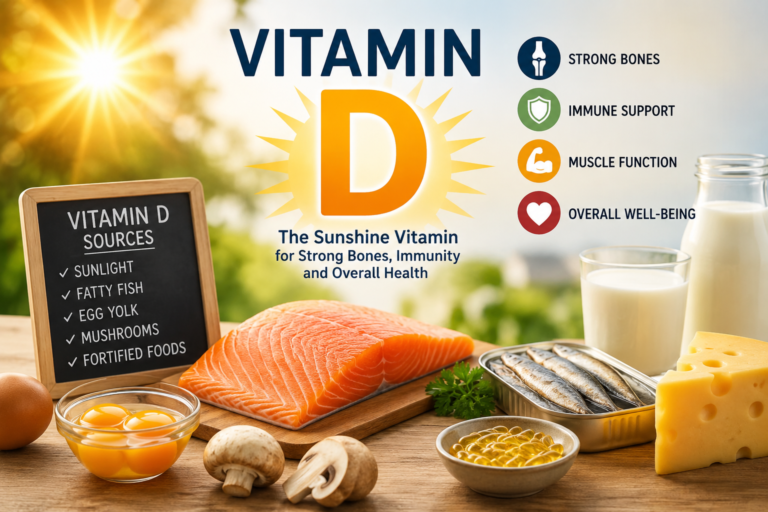
All About Vitamin D Benefits, Sources, Dosage, Deficiency & Side Effects-21 Powerful facts
Introduction
- Vitamin D is one of the most essential and powerful nutrients for maintaining overall health. Commonly known as the Sunshine Vitamin, it is unique because the human body can naturally produce it when the skin is exposed to sunlight. Unlike traditional vitamins, Vitamin D functions more like a hormone, influencing numerous biological processes that support strength, vitality, and long-term wellness.
- This remarkable nutrient plays a crucial role in calcium absorption, bone development, immune defense, muscle performance, and overall physiological balance. Adequate Vitamin D levels are associated with stronger bones, enhanced immunity, improved physical function, and better quality of life. However, despite abundant sunlight in many regions, Vitamin D deficiency has become a widespread and growing health concern worldwide.
- Modern lifestyles, limited outdoor activity, air pollution, aging, and poor dietary habits have significantly increased the risk of deficiency. Low Vitamin D levels may contribute to fatigue, weakness, reduced immunity, bone loss, muscle discomfort, and other health challenges that often remain unnoticed for years.
- Fortunately, Vitamin D deficiency is both preventable and manageable through sensible sun exposure, nutritious foods, and appropriate supplementation. Understanding its functions, sources, benefits, dosage recommendations, and safety considerations is essential for maintaining optimal health. This comprehensive guide explores every important aspect of Vitamin D, from its scientific background and medicinal uses to its health benefits, deficiency risks, and latest research findings.
Research Studies on Vitamin D
Modern science has produced some of the most compelling evidence in nutritional research around Vitamin D — and the findings are impossible to ignore.
- VITAL Trial (2019) — New England Journal of Medicine The largest Vitamin D RCT ever conducted. 25,871 adults supplemented with 2,000 IU/day for 5 years. Result: a significant 17% reduction in total cancer mortality and a 25% reduction in deaths from cancers diagnosed after the first year. A landmark finding that changed how oncologists view Vitamin D.
- COVID-19 Research (2020–2022) Multiple meta-analyses confirmed that Vitamin D deficiency was independently associated with higher COVID-19 severity, ICU admission, and mortality. A Spanish RCT demonstrated that high-dose calcifediol at hospital admission dramatically reduced ICU admissions among hospitalised patients.
- Vitamin D and Depression (2020 Meta-Analysis) Analysis of 61 studies involving 9,484 patients showed Vitamin D supplementation significantly reduced depressive symptoms in deficient individuals — producing effects comparable to antidepressant medication in mild-to-moderate cases.
- Martineau et al. (2017) — BMJ Landmark meta-analysis of 25 randomised trials proved that Vitamin D supplementation significantly protected against acute respiratory infections — with the strongest protective effect seen in those who were most severely deficient.
- Vitamin D and Gut Microbiome (2023) Emerging research reveals that Vitamin D actively shapes gut microbiome diversity, promoting beneficial Lactobacillus and Bifidobacterium species — opening an exciting new frontier in understanding Vitamin D’s broad immune and metabolic effects.
Types of Vitamin D
Not all Vitamin D is created equal — and knowing the difference genuinely matters for your health.
- Vitamin D2 (Ergocalciferol) comes from plants, fungi, and UV-exposed mushrooms. It is less potent, absorbed less efficiently, and exits the body faster. Many fortified foods use D2 because it is cheaper to produce — but it is the inferior choice.
- Vitamin D3 (Cholecalciferol) is the form your skin naturally produces from sunlight. Research consistently proves it raises blood levels faster, higher, and for longer than D2. This is the form worth supplementing with.
- Calcitriol is the fully active hormonal form — produced in the kidneys from D3 — that actually binds to receptors throughout your body and triggers Vitamin D’s powerful biological effects.
What is Vitamin D? The Sunshine Vitamin That Powers Your Entire Body
- Vitamin D is a fat-soluble prohormone that your body produces naturally when sunlight touches your skin. Unlike most vitamins that must come entirely from food, Vitamin D is unique — your skin manufactures it using ultraviolet-B rays from the sun, which is why it earned the name “Sunshine Vitamin.”
- It exists in two key forms: Vitamin D2 from plant and fungal sources, and the more potent Vitamin D3, produced by your skin and found in animal-based foods. Once inside the body, it gets activated by the liver and kidneys before binding to receptors in nearly every tissue — bones, muscles, brain, immune cells, and heart.
- This is exactly why Vitamin D is far more than a bone vitamin. It regulates calcium absorption, strengthens immunity, supports muscle function, stabilises mood, and influences over 2,000 genes in the human body. No other single nutrient does so much, so quietly.
- Tragically, despite all this, Vitamin D deficiency affects an estimated one billion people worldwide — and most never know it. Fatigue, weak muscles, low mood, and frequent infections are the silent warning signs that go unnoticed for years.
Scientific Classification of Vitamin D
Vitamin D belongs to the secosteroid family — a subclass of steroids where one molecular ring is broken open, giving it a hormonal structure unlike any traditional vitamin. Its closest biological relatives are steroid hormones like estrogen and cortisol, which explains why it behaves more like a hormone than a simple nutrient.
Classification Details
| Classification Parameter | Details |
|---|---|
| Nutrient Category | Fat-Soluble Vitamin |
| Chemical Class | Secosteroid |
| Biological Nature | Prohormone |
| Primary Forms | Vitamin D2 (Ergocalciferol), Vitamin D3 (Cholecalciferol) |
| Storage Form | Calcidiol [25(OH)D] |
| Active Form | Calcitriol [1,25(OH)₂D] |
| Major Function | Calcium and Phosphorus Regulation |
| Main Source | Sunlight Exposure, Food, Supplements |
| Molecular Formula (Vitamin D3) | C₂₇H₄₄O |
| Molecular Weight |
Natural Sources of Vitamin D
The most powerful and completely free source of Vitamin D is something most people already have access to — direct sunlight.
When ultraviolet-B rays strike bare skin between 10 AM and 3 PM, your body converts a naturally occurring skin compound (7-dehydrocholesterol) into Vitamin D3 within minutes. For fair skin, just 15 to 20 minutes of midday sun exposure on the arms and legs can generate 10,000 to 20,000 IU — far more than any supplement or food source can provide.
However, several factors dangerously reduce this natural synthesis:
- Darker skin pigmentation requires 3 to 5 times longer exposure
- Sunscreen with SPF 30 blocks up to 95% of UVB radiation
- Glass windows filter out all UVB — indoor sunlight produces zero Vitamin D
- Air pollution, cloud cover, and winter months significantly limit effective UVB
- People over 65 synthesise Vitamin D at just 25% the efficiency of younger adults
UV-exposed mushrooms are the only meaningful plant-based natural source — place them gills-up in direct sunlight for two hours and their Vitamin D2 content increases dramatically.
Food Sources of Vitamin D
Food alone cannot realistically meet most people’s Vitamin D requirements — but choosing the right sources makes a meaningful difference.
| Food Source | Vitamin D Content (approx.) |
|---|---|
| Cod liver oil (1 tbsp) | 1,360 IU |
| Salmon, cooked (100g) | 447–600 IU |
| Mackerel, cooked (100g) | 360 IU |
| Sardines, canned (100g) | 193 IU |
| Tuna, canned (100g) | 268 IU |
| UV-exposed mushrooms (100g) | 400+ IU |
| Egg yolk (1 whole) | 37–44 IU |
| Fortified milk (1 cup) | 100 IU |
| Fortified orange juice (1 cup) | 100 IU |
| Beef liver (100g) | 42 IU |
- Fatty fish and cod liver oil are by far the richest natural food sources. For vegetarians and vegans, UV-exposed mushrooms and fortified plant milks are the most reliable dietary options — though supplementation remains strongly recommended to reach truly optimal Vitamin D levels.
Proven Health Benefits of Vitamin D
Vitamin D is not a single-purpose nutrient — it is a whole-body protector. When levels are optimal, the difference in how you feel, function, and recover is genuinely remarkable.
- Stronger Bones and Teeth Vitamin D is the only nutrient that makes calcium absorption possible at meaningful levels. Without it, bones silently lose density year after year — long before any pain or fracture signals the damage already done.
- Powerful Immune Defense Vitamin D activates the immune system’s first-line soldiers — antimicrobial peptides that directly destroy bacteria, viruses, and fungi. Deficient individuals get sick more often, recover more slowly, and face significantly higher infection risk.
- Sharper Mood and Mental Clarity Vitamin D receptors in the brain regulate serotonin production. Low levels are directly linked to depression, anxiety, brain fog, and Seasonal Affective Disorder. Correcting deficiency often produces a noticeable, life-changing improvement in mental wellbeing.
- Stronger Muscles and Better Physical Performance Vitamin D is essential for muscle fibre development and neuromuscular coordination. Athletes with optimal Vitamin D levels demonstrate measurably better strength, faster recovery, and significantly lower injury rates.
- Cardiovascular Protection Vitamin D regulates blood pressure through the renin-angiotensin system, reduces dangerous vascular inflammation, and supports healthy heart function — making it a critical but frequently ignored pillar of cardiovascular health.
- Blood Sugar Balance Pancreatic beta cells — the cells responsible for producing insulin — are packed with Vitamin D receptors. Deficiency impairs insulin secretion and worsens insulin resistance, significantly increasing Type 2 Diabetes risk.
- Cancer Risk Reduction Active Vitamin D suppresses abnormal cell growth, promotes cancer cell death, and blocks tumour blood supply formation. Higher Vitamin D levels are consistently associated with lower rates of colorectal, breast, and prostate cancer.
- Healthy Pregnancy and Fetal Development Vitamin D deficiency during pregnancy is dangerously linked to gestational diabetes, preeclampsia, premature birth, and impaired fetal bone and brain development. Adequate levels protect both mother and child profoundly.
Chemical Composition of Vitamin D
Vitamin D3 (cholecalciferol) has a distinctive open-ring molecular structure that separates it from conventional steroids and explains its powerful hormonal behaviour.
| Property | Details |
|---|---|
| Molecular Formula | C₂₇H₄₄O |
| Molecular Weight | 384.64 g/mol |
| Appearance | White crystalline powder |
| Solubility | Fat-soluble; insoluble in water |
| Melting Point | 83–86°C |
| Stability | Sensitive to light, heat, and oxygen |
| Key Metabolites | Calcidiol (storage), Calcitriol (active) |
Its fat-soluble nature means Vitamin D stores in adipose tissue and the liver — a double-edged reality. Storage allows the body to draw on reserves during sun-scarce winter months, but it also means excess supplementation can accumulate to toxic levels over time.
Vitamin D Dosage — How Much Do You Actually Need?
Getting Vitamin D dosage right is critical. Too little leaves you deficient. Too much — taken recklessly through supplements — can cause genuine harm. The goal is optimal, not excessive.
| Population Group | Recommended Daily Intake | Optimal Target (Expert Guidance) |
|---|---|---|
| Infants (0–12 months) | 400 IU | 400–1,000 IU |
| Children (1–18 years) | 600 IU | 600–2,000 IU |
| Adults (19–70 years) | 600–800 IU | 1,500–4,000 IU |
| Adults over 70 | 800 IU | 2,000–6,000 IU |
| Pregnant Women | 600 IU | 1,500–4,000 IU |
| Breastfeeding Women | 600 IU | 4,000–6,000 IU |
| Clinically Deficient | Physician-guided | 5,000–10,000 IU (short-term) |
Critical Tips for Maximum Absorption Always take Vitamin D3 — not D2. Take it with a fat-containing meal — absorption increases by up to 50%. Co-supplement with Magnesium (200–400 mg) and Vitamin K2 (MK-7) for safe, effective results. Retest blood levels after 3 months to confirm correction.
Vitamin D Deficiency — The Silent Epidemic
Vitamin D deficiency is one of the most widespread and most ignored health crises of modern times. An estimated one billion people worldwide are deficient — and the majority have absolutely no idea.
Warning Signs of Vitamin D Deficiency
- Persistent fatigue that rest cannot fix
- Unexplained muscle weakness and body aches
- Frequent colds, infections, and slow recovery
- Low mood, depression, or seasonal sadness
- Bone pain — particularly in the back, hips, and legs
- Slow wound healing and hair loss
- Brain fog and difficulty concentrating
Who Is at Dangerous Risk?
- People working indoors with minimal sun exposure
- Individuals with darker skin pigmentation
- Adults over 65 — skin efficiency drops by 75%
- Obese individuals — fat tissue traps and sequesters Vitamin D
- Pregnant and breastfeeding women
- People with gut disorders — Crohn’s, celiac, IBS
- Exclusively breastfed infants — breast milk contains virtually no Vitamin D
Consequences of Untreated Deficiency
In children, severe deficiency causes rickets — painful, deforming, and entirely preventable. In adults, it leads to osteomalacia (bone softening), progressive bone density loss, collapsed immunity, and significantly increased risk of chronic disease. The longer deficiency goes undetected, the more irreversible the damage becomes.
A simple blood test measuring serum 25(OH)D levels is all it takes to know where you stand. Below 20 ng/mL is deficient. Below 30 ng/mL is insufficient. Optimal is 40 to 60 ng/mL — and most people are nowhere near it.
Side Effects of Vitamin D
At recommended doses, Vitamin D is extraordinarily safe. Problems arise exclusively from reckless, prolonged over-supplementation — a condition called hypervitaminosis D — which causes dangerously elevated blood calcium levels (hypercalcaemia).
Symptoms of Vitamin D Toxicity
- Persistent nausea, vomiting, and loss of appetite
- Excessive thirst and frequent urination
- Severe fatigue and confusion
- Kidney stones and progressive kidney damage
- Dangerous calcium deposits in arteries, heart, and lungs
- Cardiac arrhythmias in severe cases
Toxicity almost never occurs below 10,000 IU daily and is virtually impossible from sunlight alone — the skin has a built-in self-regulation mechanism that prevents overproduction. The danger lies exclusively in unsupervised, high-dose supplementation taken recklessly over extended periods.
Who Should Be Especially Cautious
People with hyperparathyroidism, sarcoidosis, granulomatous diseases, kidney disease, or a history of calcium kidney stones must consult a doctor before supplementing — these conditions make hypercalcaemia risk genuinely serious.
Frequently Asked Questions About Vitamin D
Q1. What are the symptoms of Vitamin D deficiency?
The most common — and dangerously easy to ignore — symptoms of Vitamin D deficiency include persistent fatigue, unexplained bone and muscle pain, frequent infections, low mood or depression, hair loss, slow wound healing, and a general feeling of weakness. The alarming reality is that many people carry a serious deficiency for years without a single obvious symptom. A blood test measuring serum 25(OH)D is the only reliable way to confirm it.
Q3. Which foods are highest in Vitamin D?
Cod liver oil tops the list at around 1,360 IU per tablespoon. Fatty fish — salmon, mackerel, sardines, and tuna — are the next most powerful dietary sources. Egg yolks, beef liver, and UV-exposed mushrooms contribute meaningful amounts. Fortified milk, plant milks, and cereals add roughly 100 IU per serving. The honest truth is that diet alone rarely provides enough — most people still need supplementation.
Q5. Can too much Vitamin D be harmful?
Yes, but only through reckless over-supplementation — not through sunlight or food. Excessive Vitamin D causes dangerously high blood calcium (hypercalcaemia), leading to nausea, kidney stones, fatigue, confusion, and in severe cases, heart and kidney damage. Toxicity is essentially impossible below 10,000 IU daily and is completely avoidable with sensible dosing and periodic blood testing.
Q7. Does Vitamin D help with depression and anxiety?
Growing evidence says yes — particularly in people who are deficient. Multiple clinical trials and meta-analyses show that correcting low Vitamin D levels produces measurable improvements in depressive symptoms and mood stability. Vitamin D receptors are found throughout the brain in regions that regulate serotonin and dopamine. It is not a replacement for professional mental health care, but ignoring Vitamin D status in someone with depression is a serious and avoidable oversight.
Q9. Can Vitamin D prevent cancer?
Research is genuinely promising, especially for colorectal cancer. A 2025 review of over 50 studies and more than one million participants confirmed that higher Vitamin D levels were associated with significantly reduced colorectal cancer risk and improved survival. The landmark VITAL trial demonstrated a 17% reduction in overall cancer mortality with daily Vitamin D3 supplementation. While it is not a proven cancer cure, maintaining optimal Vitamin D levels is a powerful and evidence-supported risk-reduction strategy.
Q2. How much Vitamin D do I need per day?
Most healthy adults need 600–800 IU daily as the official minimum, but most nutrition experts now consider 1,500–4,000 IU daily as the genuinely optimal range for maintaining sufficient blood levels. People who are deficient, elderly, obese, or have darker skin typically need significantly more. Always test before self-prescribing high doses.
Q4. Is Vitamin D3 better than Vitamin D2?
Yes — conclusively. Vitamin D3 (cholecalciferol) raises blood levels up to 87% more effectively than Vitamin D2 and sustains those levels for far longer. D3 is the form your skin naturally produces and the form backed by the strongest clinical evidence. Always choose D3, whether from lanolin-based or vegan lichen-based supplements.
Q6. How long does it take for Vitamin D supplements to work?
Blood levels typically begin rising noticeably within 4–8 weeks of consistent daily supplementation. Symptoms like fatigue, low mood, and muscle weakness generally improve within 4–12 weeks of correcting deficiency. Bone-related improvements take longer — often 6–12 months of sustained adequate levels. Always retest after 3 months to confirm your levels have actually corrected.
Q8. What is the normal Vitamin D level in blood?
Serum 25(OH)D is the standard measurement. Below 20 ng/mL is clinically deficient. Between 20–29 ng/mL is insufficient. Between 30–50 ng/mL is considered sufficient. Between 40–60 ng/mL is where most researchers and clinicians now consider levels truly optimal — where the most meaningful health benefits are observed. Above 100 ng/mL risks toxicity.
Q10. Should I take Vitamin D with K2 and magnesium?
Strongly advisable. Magnesium is essential for activating Vitamin D in the liver and kidneys — without it, supplementation is far less effective. Vitamin K2 (MK-7) directs the extra calcium that Vitamin D mobilises safely into bones rather than dangerously into arteries. Taking high-dose Vitamin D alone — without K2 and magnesium — is an increasingly recognised missed opportunity at best, and a potential cardiovascular risk at worst.
Back To Home

Ayuage is a trusted platform dedicated to sharing practical, easy-to-understand, and reliable insights on health, nutrition, wellness, and healthy living. Our goal is to simplify important health topics and provide readers with helpful information that supports smarter food choices and a balanced lifestyle.