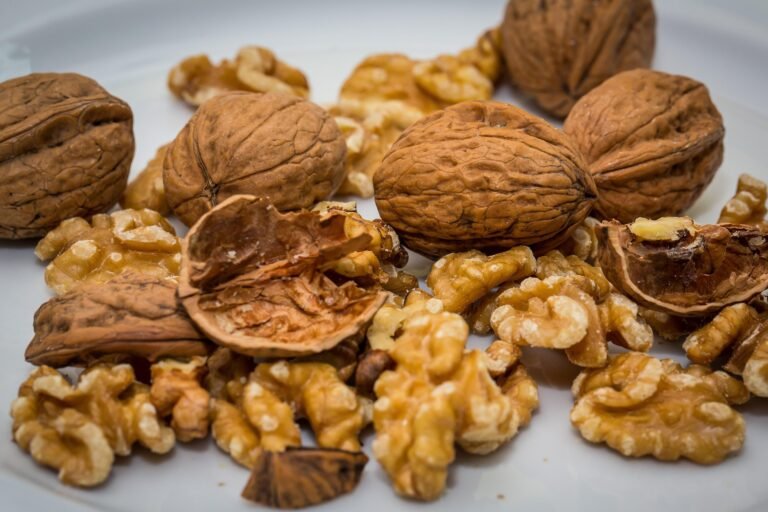
All About Walnut (Juglans regia Linn) | अखरोट की पूरी जानकारी : Benefits, Uses, Nutrition & Botanical Information
Overview
- All About Walnut (Juglans regia Linn) | अखरोट की पूरी जानकारी : Benefits, Uses, Nutrition & Botanical Information — Walnut (Juglans regia Linn), commonly referred to as Akhrot in Hindi, is a deciduous and visually striking tree species valued worldwide for its nutrient-rich edible seeds, high-quality timber, and diverse applications. It belongs to the genus Juglans and is widely cultivated across temperate regions due to its economic and nutritional significance.
- Walnut trees exhibit variation in growth patterns and fruit characteristics depending on environmental conditions and the structure of the inner shell (endocarp). They are generally classified into two main categories: wild walnuts and cultivated walnuts. Wild walnut trees grow naturally and can reach heights of approximately 30–40 meters, producing fruits with thick, hard shells. In contrast, cultivated varieties are typically smaller, ranging between 15–25 meters in height, and are known for their thin-shelled or “paper-shell” nuts, which are easier to crack and commercially more desirable. The kernels of cultivated walnuts are light-colored, flavorful, and highly nutritious.
- Beyond their edible value, walnut trees are also prized for their premium-quality wood, which is widely used in fine furniture, veneers, carvings, and high-grade applications such as gunstocks due to its strength, durability, and attractive grain.
- Walnuts are predominantly found in temperate mountainous regions and have a wide geographical distribution. They grow extensively across the Himalayan belt, from Kashmir to Manipur, and are also native to regions including Afghanistan, Iran, China, Pakistan, Nepal, Bhutan, and Turkey. In India, walnut trees are commonly found at elevations ranging from 1000 to 3000 meters, particularly in Uttarakhand and northeastern regions. Historically, walnuts are believed to have originated in Central Asia, especially in parts of modern-day Iran and Afghanistan, from where they spread globally.
- Today, walnut remains one of the most important and widely recognized nut-bearing trees, valued for its nutritional benefits, commercial applications, and global agricultural importance.
Walnut In Different Languages
- Although walnut is globally recognized by the English name ‘Walnut’, its local names vary widely across countries and languages, reflecting its long history of cultivation and cultural importance
Sanskrit (संस्कृत)
Shailbhava (शैलभवः), Gudashaya (गुडाशयः), Kireshta (कीरेष्टः), Swadumajja (स्वादुमज्जः), Vrikshaphalam (वृक्षफलम्), Parvatiya (पार्वतीयः), Snehaphalam (स्नेहफलम्), Akshota (अक्षोटः), Akshotaka (अक्षोटकः), Karparala (कर्परालः)
Hindi (हिन्दी)
Akhrot (अखरोट), Akrot (अक्रोट), Akhor (अखोर)
Assamese (অসমীয়া)
Akhrot (अखरोट), Akrot (अक्रोट), Akhor (अखोर)
Urdu (उर्दू)
Akhrot (اخروٹ)
English
Common Walnut, Persian Walnut, European Walnut
Arabic (العربية)
Joz, Jauz, Jajejul-e-Hind
Persian (فارسی)
Charmaghz, Girdagan
United States (USA)
Walnut / English Walnut
Saudi Arabia (السعودية)
Jauz (جوز)
Greece (Ελλάδα)
Karydi (καρύδι)
Portugal (Portugal)
Noz
Italy (Italia)
Noce
Spain (España)
Nuez
France (France)
Noix
Germany (Deutschland)
Walnuss
Germany (Deutschland)
Walnuss
Russia (Россия)
Gretsky Orek (грецкий орех)
Japan (日本)
Kurumi (くるみ)
China (中国)
Hetao (核桃)
Turkey (Türkiye)
Ceviz
Iran (ایران)
Ceviz
Afghanistan (افغانستان)
Chaar Maghz (چار مغز)
Nepal (नेपाल)
Okhara (ओखरा)
Pakistan (پاکستان)
Akhrot (اخروٹ)
Physical Appearance of Walnut
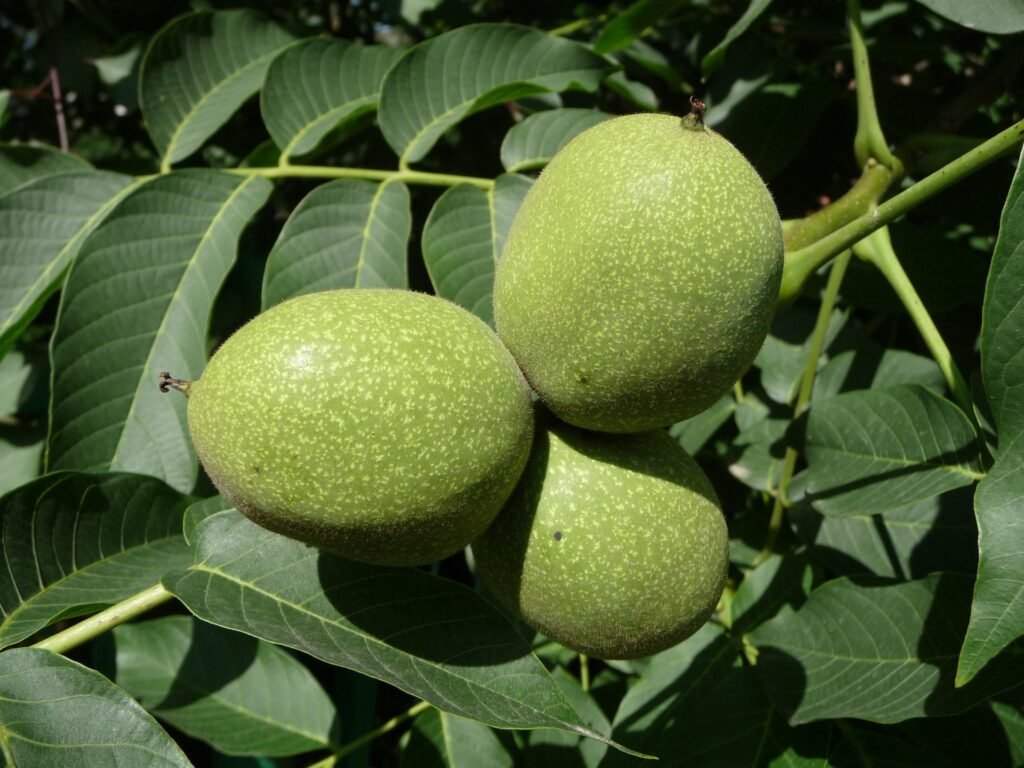
- Tree :- The walnut tree is a large, strong, and deciduous tree that can grow up to 30–40 meters in height, depending on the species and environmental conditions. It has a broad, spreading crown with thick branches that give the tree a wide and majestic appearance. The trunk is usually straight and covered with rough, grayish-brown bark that becomes deeply cracked as the tree ages. Walnut trees are long-living and are commonly found in temperate regions with cool winters and moderate rainfall.
- Leaves : – Walnut leaves are large, compound, and arranged alternately on the branches. Each leaf is made up of several smaller leaflets attached to a central stalk. The leaflets are oval or elongated in shape with smooth edges and pointed tips. They are bright green during the growing season and may turn yellow before falling in autumn. When crushed, walnut leaves produce a distinct aromatic smell due to the natural oils and compounds present in them.
- Stem and Branches : –The stem or trunk of the walnut tree is thick, woody, and very strong. Young branches are smooth and greenish-brown, while older branches become darker and rougher over time. The wood of the walnut tree is highly valued because of its durability, strength, and attractive dark color. Walnut wood is commonly used in furniture, carving, flooring, and decorative items.
- Flowers : – Walnut trees produce separate male and female flowers on the same tree. The male flowers appear as long hanging catkins that release pollen into the air, while the female flowers are smaller and grow near the ends of branches. Flowering usually occurs during spring before or along with the development of new leaves.
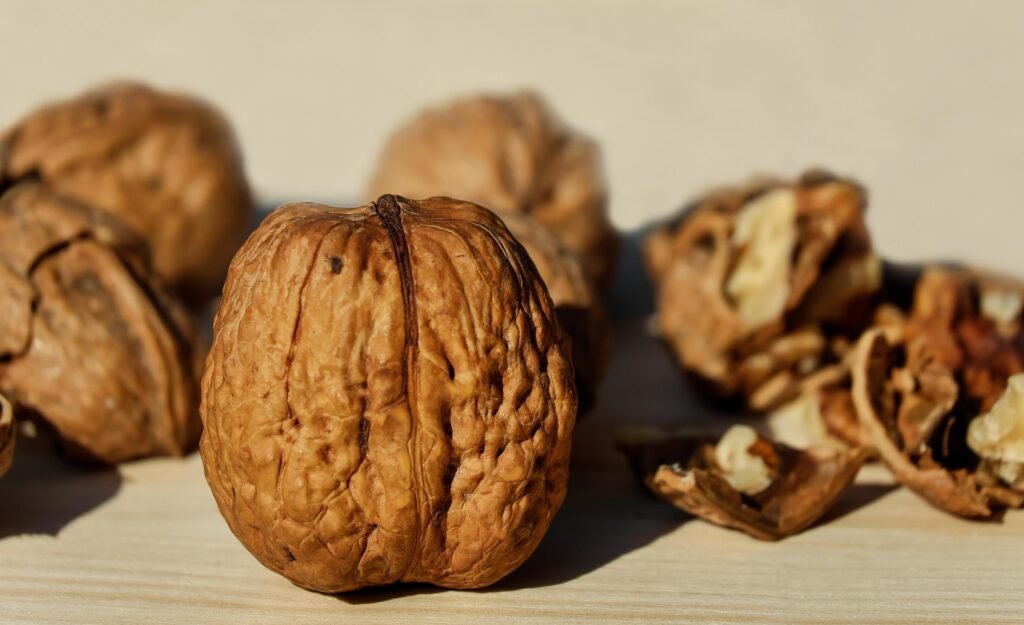
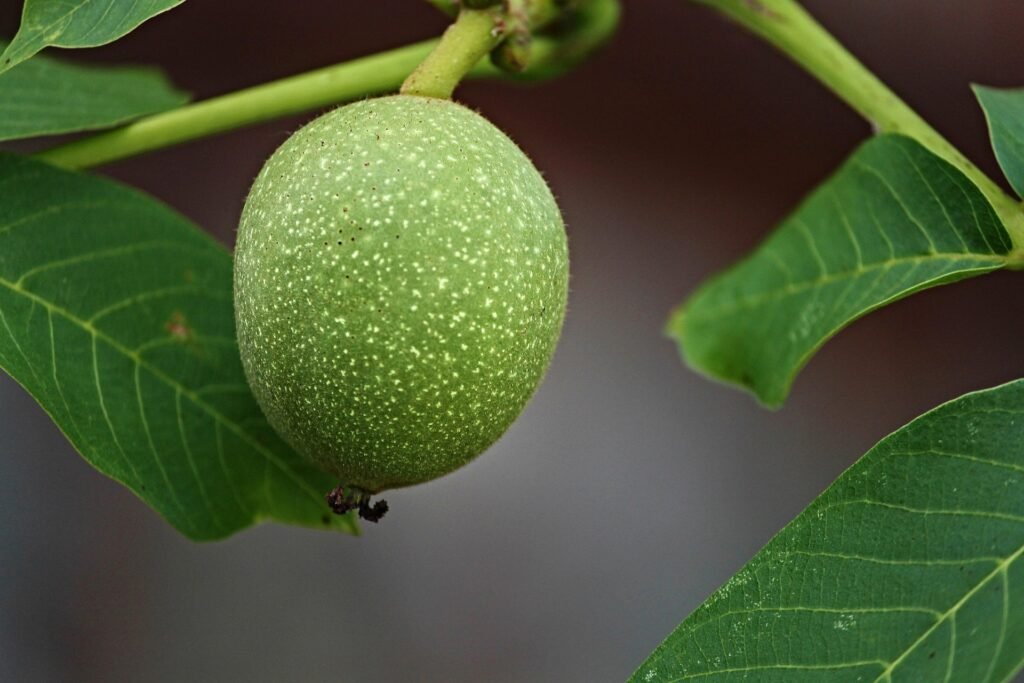
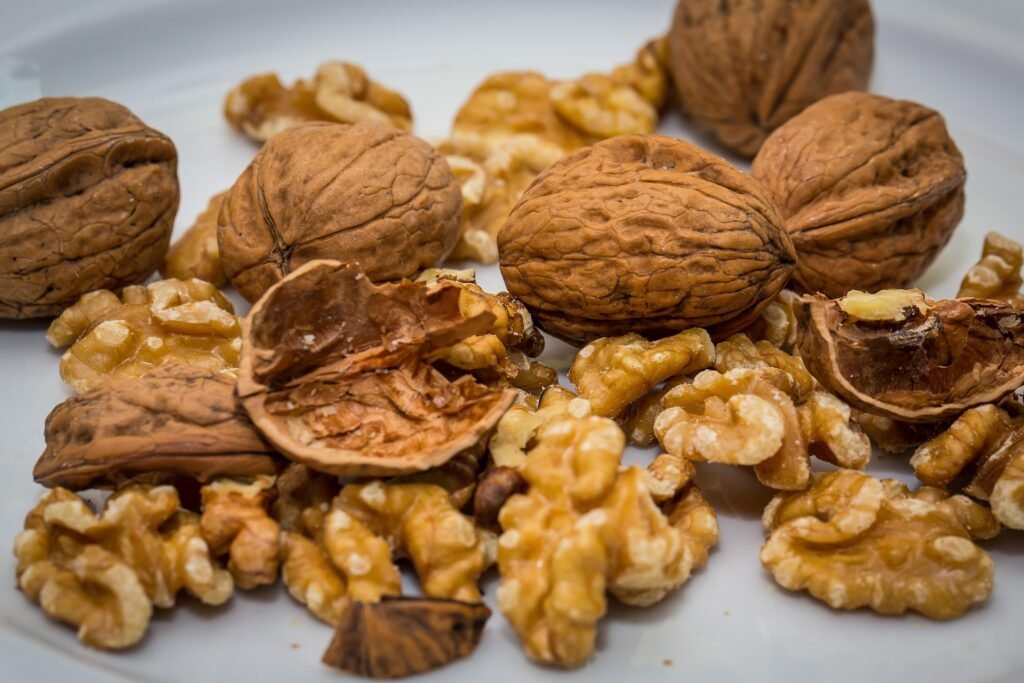
- Fruit : – The fruit of the walnut tree is round or oval and consists of two main layers. The outer covering is a thick green husk that is smooth and fleshy when fresh. As the fruit matures, the husk dries, cracks open, and reveals the hard shell inside. Inside this shell lies the edible walnut kernel. The kernel has a brain-like appearance with folded surfaces and is light brown in color. Walnuts are rich in nutrients and are widely consumed as dry fruits around the world.
- Shell: – The walnut shell is hard, woody, and light brown in color. It protects the edible seed inside from physical damage and environmental conditions. The shell has deep grooves and requires pressure or tools to crack open.
Botanical Description of Walnut (Juglans regia Linn)
- The tree is large, deciduous, and well known for its height, strength, and long lifespan. The bark is grey in color and becomes rough and vertically cracked as the tree grows older. The wood is strong, durable, and beautifully textured, which makes it highly valuable for making quality furniture, decorative items, and specialized wooden products.
- The leaves are compound and fairly large, with pointed tips and slightly toothed margins. They feel thick and somewhat leathery to the touch. Being a deciduous tree, it sheds its leaves during the winter season, and new leaves start appearing from late winter to early spring. The flowering period usually occurs in spring, when small, light-colored flowers grow in clusters at the ends of the branches. Both male and female flowers are present on the same tree.
- The tree takes many years to mature, and fruiting generally starts after about three to four decades. The fruits are round in shape with a somewhat rough and wrinkled outer covering. Inside the fruit, the edible kernel is divided into two parts and resembles the structure of a human brain. The kernel contains a high amount of oil and is highly nutritious.
- The seed inside the fruit is irregular, wrinkled, and greyish-white in color. The flowering and fruiting period generally extends from February to August, depending on the climate and location. Several varieties are found in different regions, among which the thin-shelled variety is considered the best due to its larger fruit size and better quality kernel. When the fruits are young and tender, they are sometimes used for making pickles, while the fully matured kernels are widely used as dry fruits. The bark is also used for dyeing and medicinal purposes, and the green outer covering of the fruit has traditionally been used for natural hair coloring.
Chemical composition of Walnut (Juglans regia Linn)
- Walnut (Juglans regia Linn), also known as Akhrot, is rich in nutrients and contains a high amount of fats, proteins, carbohydrates, vitamins, minerals, and bioactive compounds. The kernel mainly contains about 60–70% healthy fats, especially polyunsaturated fatty acids such as omega-3 and omega-6 fatty acids, along with a moderate amount of protein and a small amount of carbohydrates including dietary fiber. Walnuts are also a good source of vitamins such as vitamin E and B-complex vitamins, and minerals like magnesium, phosphorus, potassium, calcium, iron, and zinc. In addition, walnuts contain important bioactive compounds such as polyphenols, flavonoids, and tannins, which have antioxidant properties and are beneficial for human health. Due to its rich chemical composition, walnut is considered a highly nutritious and health-supporting food.
Properties, Actions and Effects
- In traditional Ayurvedic texts, walnut is described as a highly nourishing and strengthening natural food. It is considered Vata-shamaka (helps in balancing Vata), while it may increase Kapha and Pitta if taken in large quantities. Because of its nourishing nature, it is often regarded as a brain tonic (Medhya), a digestive stimulant (Deepana), and a lubricating food (Snehan) that helps maintain proper bowel movement and supports digestion. For this reason, it has traditionally been included in strengthening diets, especially during cold seasons.
- Walnut is also described as Balakaraka (strength-giving), Vrishya (supportive for reproductive health), and Brimhana (body nourishing), which means it helps in improving physical strength and overall body nourishment when consumed regularly in moderate amounts. In many traditional practices, it has been recommended for people who need energy, strength, and mental support.
- When applied externally in paste form, walnut is considered beneficial for improving skin complexion (Varnya), managing certain skin disorders (Kushthaghna), reducing swelling (Shothahara), and relieving pain (Vedanasthapaka). These traditional uses suggest that walnut has soothing and anti-inflammatory properties.
- Walnut oil is described as sweet in taste, cooling in effect, and heavy in nature. It is considered helpful in balancing Vata and Pitta, while slightly increasing Kapha. Traditionally, walnut oil has been used for hair care, as it is believed to support hair health and scalp nourishment. It has also been mentioned in traditional medicine for its role in certain blood-related conditions.
- From a modern scientific point of view, walnut has been found to possess antimicrobial, anti-inflammatory, antioxidant, antiviral, and antifungal properties. Some studies also suggest that it may help in managing blood sugar levels, support thyroid hormone activity, and provide protective effects against aging due to its antioxidant content. Because of its effect on the nervous system, it is sometimes also considered helpful in mental fatigue and weakness.
- The leaves of the tree are described as astringent, strength-promoting, and useful in controlling intestinal worms, while the bark is traditionally used for its protective effect in cold conditions and for supporting proper movement of Vata in the body.
- Experimental studies have also shown that methanolic extract of walnut fruit has demonstrated anti-diabetic activity in laboratory animals, and extracts from different parts of the plant have shown antimicrobial activity against certain microorganisms. These findings support many of the traditional uses described in Ayurvedic literature.
- Overall, both traditional knowledge and modern research suggest that walnut is not only a nutritious food but also a plant with significant medicinal value.
Walnut Medicinal Uses in Different Diseases
Eye Diseases :-
- Improves eyesight – Apply ash made from burnt walnut and harad with black pepper as kajal; it helps increase eyesight.
Old traditional remedy people used when glasses were not common. - Complete Herbal Care for Eye Diseases
Mouth Diseases :–
- Tooth problems – Brush with ash of walnut shell and rock salt; it makes teeth strong.
Natural tooth powder like old Ayurvedic manjan. - Dental diseases – Chewing walnut bark helps in tooth and mouth diseases.
- Burning in palate – Applying paste of tree bark helps reduce burning.
- Bleeding gums – Applying powder of walnut bark etc. stops bleeding from gums.
This remedy is still used in villages. - Complete Herbal Care for Mouth Diseases
Throat Diseases
- Goiter / throat swelling – Drinking walnut bark decoction helps.
- Throat inflammation – Eating walnut kernel is beneficial.
Walnut is warm in nature, so it helps in throat issues. - Complete Herbal Care for Throat Diseases
Chest Diseases
- Lung weakness – Taking medicated ghee made with walnut is helpful.
- Cough – Eat lightly roasted walnut; it helps in cough.
Especially useful in winter season. - Complete Herbal Care for Chest Diseases
Stomach Diseases
- Diarrhea – Drinking decoction of walnut leaves helps.
- Constipation – Drinking walnut oil with milk helps clear stomach.
- Cholera – Body massage with walnut oil helps during cholera cramps.
- Intestinal worms – Walnut oil or decoction helps remove worms.
Walnut oil was used as natural stomach cleanser. - Complete Herbal Care for Stomach Pain
Piles & Rectum Diseases
- Piles pain – Applying walnut oil reduces pain.
- Bleeding piles – Taking ash of walnut bark helps stop bleeding.
Kidney & Urine Diseases
- Prameha (Urinary disorder/Diabetes type) – Eating mixture of walnut, dates and sugar helps.
But this should be taken with doctor advice. - Complete Herbal Care for Kidney and Urine Diseases
Reproductive System
- Increase breast milk – Eating wheat and walnut cooked in ghee helps increase milk.
- Menstrual problems – Walnut decoction with honey helps in blocked menstruation and pain.
- Semen problems – Walnut shell ash with sugar helps stop sperm leakage.
- Complete Herbal Care for Reproductive System
Skin Diseases
- Ringworm – Chewing walnut and applying helps.
- Wound – Washing wound with walnut bark decoction heals faster.
- Itching / Skin infection – Applying walnut bark paste helps.
Walnut has natural antibacterial properties. - Complete Herbal Care for Skin Diseases
Mental Diseases
- Brain weakness – Eating 25–50 g walnut daily makes brain strong.
Walnut looks like brain and is actually good for brain. - Epilepsy – Walnut paste with herbal juice used as traditional treatment.
- Complete Herbal Care for Mental Diseases
Whole Body Diseases
- Joint pain / Arthritis – Applying walnut paste reduces pain.
- Swelling – Walnut oil helps reduce body swelling.
- Body strength – Eating walnut with raisins daily increases strength.
That’s why walnut is called a power food. - Complete Herbal Care for Whole body Diseases
Walnuts are rich in omega-3 fatty acids, antioxidants, and vitamins that support heart health, brain function, and overall immunity. Regular consumption helps improve memory and reduce inflammation.
Yes, walnuts are often called “brain food” because they contain nutrients that support memory, focus, and overall brain function.
Generally, 4–6 walnuts per day are considered safe and beneficial for most people.
Yes, walnuts help reduce bad cholesterol (LDL) and improve heart health due to their healthy fats.
Walnuts can support weight loss when eaten in moderation because they keep you full for longer and reduce cravings.
Yes, walnut oil and kernels help improve skin glow and strengthen hair due to their vitamin E and healthy fats.
Yes, walnuts may help control blood sugar levels, but they should be consumed in moderation
The best time to eat walnuts is in the morning on an empty stomach or as a healthy snack.
Yes, walnuts contain fiber which helps improve digestion and supports gut health
Yes, walnuts can be eaten daily in moderate amounts as part of a balanced diet.

Ayuage is a trusted platform dedicated to sharing practical, easy-to-understand, and reliable insights on health, nutrition, wellness, and healthy living. Our goal is to simplify important health topics and provide readers with helpful information that supports smarter food choices and a balanced lifestyle.